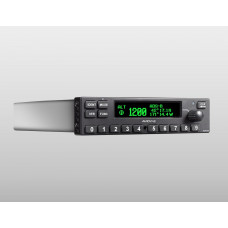
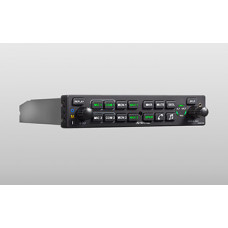
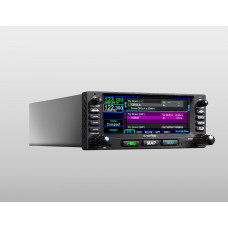
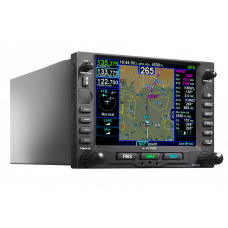
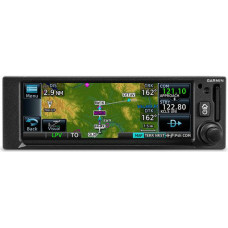
GPS Navigation System with very high accuracy built in Pressure
Transducer, SD card interface, Approach Mode, Flight Recorder,
GSM Modem Interface and with option of built in Flarm warning
system.
General
The LX 707 is derived from the proven LX 500
system that is fitted to the fleet of Grob 115Es (Tutors) operated
by the Royal Air Force as well as from the LX 7007 glider flight
management system. It offers in an all-in-one package a practical
point to point navigation system with a database of airfields
and airspace built in but, compared to the LX 500, the LX 707
has the important addition for the General Aviation community
of a high accuracy pressure transducer (as used in glider flight
recorders) that enables the LX 707 to provide an airfield approach
capability with both localiser and glide path information, albeit
without certification, without the need for a differential GPS
ground station. The addition of this separate height sensor, which
can be set to QNH or QFE, moves the on-board GPS from a simple
navigation assistant to one that can have real benefit for the
final approach to a waypoint or airfield after the input of runway
data.
Features
- 80 mm diameter
- 85mm long 125 mm total length
including connectors
- Weight approx 550 g
- Power requirement: 10 –
28VDC, approx 200mA
Options include
- Remote stick top control
- Additional 57 mm display units (for system expansion)
- Second seat unit
- Voice warning module
- Interface with LX electronic compass
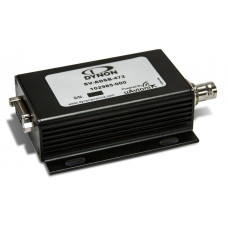
- GSM modem interface (enables on-line monitoring of the aircraft`s position)
- Integral Flarm collision avoidance system with built-in graphic display

The Database
The airport and airspace database is free and the updates are
available from www.lxnavigation.si. (LX navigation publishes updates
three times each year as a minimum.) The airspace data is in the
well known .cub format and this has the advantage of allowing
pilots to use third party sources of airspace. SeeYou .cub files
may also be loaded. In addition, LX Navigation offers a free program
called LXAs browser which enables many other airspace data formats
to be converted into .cub. It also enables the user to modify
existing .cub files. The LX 707 has sufficient memory capacity
to store up to six .cub files and this would cover virtually the
whole of Europe. A file may be recalled at any time and during
flight.
The waypoint database allows for 600 points to be entered and
also for 100 routes to be pre-programmed. (the data format is
.da4) Data transfer can be executed by use of SD card or PC.
SD Card Interface
The SD card enables a wide range of data to be easily transferred.
The SD card slot is positioned on the right hand side of the unit
and will accept a micro sized SD card. (An adapter to enable the
SD card to be inserted into a PC is included)
A pilot`s name and preferred settings for the LX 707 can be stored
on an SD card thus allowing the pilot to program the instrument
to his requirements by inserting his SD card before flight.
In Flight – navigation and approach
The primary function of the LX 707 is to provide navigation information
towards an airport or waypoint following a pre-programmed route;
each of these modes is supported by sub pages which display the
required information. The basic menu functions in Airport mode,
for example, can be controlled via this page:

For example, navigation information to a selected airport or
waypoint can be displayed like this:

Or when getting close to an airport, this time Celje in Slovenia,
the display can be like this:
and the route map can be displayed like this:

The clever feature is that the LX 707 has a precision altitude
sensor built in which has adjustment in flight for QFE/QNH etc
and this is coupled to the equally high quality GPS receiver such
as to enable a precision approach procedure to be flown after
the input of runway threshold data and the glide slope required.
( Please note that this not an EASA or otherwise certified system.)

This facility can be further extended by the addition of the
LX Compass Module that enables all key navigation information
to be displayed on the same screen.
Flarm Option
Flarm collision avoidance system may be implemented as an option.
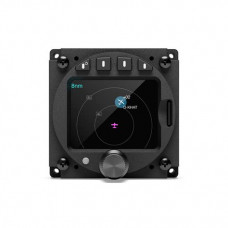
LX 707 with Flarm option offers a very usable graphic traffic
information display, which gives easily understood information
about nearby Flarm equipped traffic traffic.
The integrated Flarm option uses the LX 707 GPS receiver that
is used for navigation and no additional GPS antenna is required.
Flight Recorder Option
In addition to the electronic log book which comes as standard,
a flight recorder option may be ordered. An IGC compatible file,
albeit without secure data, may be downloaded to the SD card.
GSM Modem Interface Option
A plug and play connection to a LX GSM modem makes it possible
to both monitor the aircraft in real time on-line and also to
undertake flight analysis after flight. The LX Navigation server
is capable of playing back the last part of the flight at any
time. The log book is also available under request. All the customer
has to do is to log to the LX Navigation server and input his
personal password and user name to get access.
This map below shows the track (in yellow) and current position
(in red) of an aircraft using a LX 707 and the GSM Modem Interface
Option.

Using the GSM Modem feature may improve safety as the last aircraft
position is always known and available on internet.
System supply
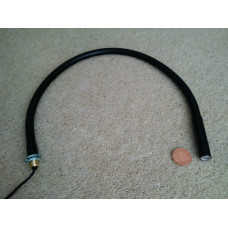
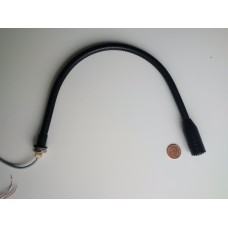
The LX 707 is supplied complete with plug and play cableset,
GPS antenna, SD Card and holder, LXe (data transfer program),
Handbook
Warranty
2 years from date of purchase
Price £975.00 excl VAT; £1145.62 incl VAT