Meanwhile please accept our sincere apologies for this further delay
to the delivery of Power Flarm.
PowerFLARM
Size and enclosure:
- length: 94mm
- width: 96mm
- height: 46mm
Controls:
- integrated rotary knob with push button
- special positive detents for tactile feedback
Audio:
- integrated warning buzzer (up to 86 dBA)
- output for headset audio (optional)
- adjustable volume
- voice-warnings (optional from Q2/2011)
Communication:
- integrated RS232 enhanced NMEA data outlet for Moving-Map or external displays
- integrated power supply for 3rd-party devices
Sensors and GPS:
- latest technology pressure sensor
- integrated microphone
- integrated 50-Channel GPS receiver
Installation:
- 2 threaded holes (M4) at the bottom
- adaptor-plates and mounts (optional)
- mountable with DualLockŪ
- fully autonomous - can be used
anywhere in the aircraft.
Display:
- sunlight readable active matrix OLED display
- resolution 220 x 176 pixels
- 2" screen size
- 180° viewing angle
- day and night mode
Power and batteries:
- 6 interchangeable AA-batteries (all types)
- adaptive battery loading circuit with temperature monitoring (NiCd and NiMh batteries)
- usable without batteries (10 to 30V DC aircraft power)
- lasts up to 8h on one charge (depends on traffic volume)
In the box:
- PowerFLARM
- ADS-B Antenna
- FLARM Antenna
- Documentation
- SD-Card
FLARM and ADS-B 1090:
- 868MHz FLARM transceiver with extended range
- supports dual antenna operation (optional)
- 1090 MHz receiver for Mode-C/S and ADS-B
- very high range (>100 NM)
- data output on ground possible (e.g. to optional PC-Software)
Antennae:
- 868MHz FLARM antenna
- second 868MHz FLARM antenna (optional)
- ADS-B antenna
- integrated GPS antenna (support for optional external antennas)
Memory:
- SD-Card slot (Micro-SD)
- more than 4GB possible
- updates through sd-card possible
Warnings Given
Power Flarm is designed to give precise warning of the relative positions
of ADS-B transmitting aircraft and of aircraft transmitting Flarm
information. Its Mode-C warning gives both distance (accuracy some
100m) and relative altitude (accuracy 25ft/50ft depending on XPDR).
It utilizes the same warning technology and motion prediction used
in FLARM. This means it calculates hazard-levels as a function of
many parameters and not only distance. (Its algorithms continually
calculate and forecast possible flight vectors and matches them to
probabilities) Warnings are given visually and acoustically depending
on the severity of the hazard.
The display and user-interface is designed to minimize distraction.
In summary it detects:
- other ADS-B equipped aircraft without PowerFLARM
- other Mode-C/S XPDR equipped aircraft ( range but
not direction)
- other aircraft with normal FLARM compatible systems
And all the time it transmits its own Flarm data making you conspicuous
to other Flarm equipped aircraft
Answers to Questions
- PowerFLARM features an NMEA Data output just like the normal FLARM, so
all FLARM-compatible display devices are also compatible with PowerFLARM, e.g. the Oudie.
- PowerFLARM also sends signals to all other FLARM compatible devices.
Price - £1,102.13 excl VAT; £1,295.00
incl VAT.
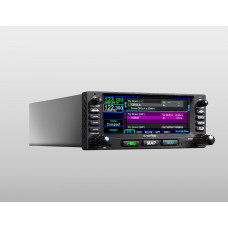
TM250 Traffic Monitor
The
TM250 is an air traffic monitoring solution the Ultralight (Microlight)
and Light Aircraft Association pilot.
The built-in receiver decodes ADS-B transmissions from
other aircraft. Their relative position is shown on the
display together with their horizontal and vertical
direction of movement. This allows an instantaneous
capture of the traffic situation.
The
traffic display TM250 by Funkwerk Avionics GmbH is aimed at supporting
air space surveillance for GA. It integrates Mode C (still under development),
S, ADS B, and FLARM ® detection in one single device for cockpit
installation. The TM-250 features an internal GPS receiver and can output
its data via another serial line to both Funkwerk-avionic and other
compatible transponders; those with ADS-B out capability.
ADS-B and Mode-S
ADS B (Automatic Dependent Surveillance – Broadcast) means
that aircraft with a Mode-S Transponder coupled to a GPS receiver
emit their position data on the frequency 1,090 MHz. This data
can be received by all airspace users up to a range of approx.
150 nm.
These ADS-B transmissions from other aircraft are decoded by
the built-in Mode-S receiver in the TM250 with the display indicating
their relative position as well as changes in the vertical plane.
This allows the TM 250 to provide a very quick assessment of the
traffic situation.
Today, the majority of Air Transport aeroplanes are equipped with ADS-B
capable systems. Because GA still has a relatively low degree of ADS-B
equipage, the TM 250 is designed also to detect aircraft with transponders
that are not sending out ADS-B signals. This is achieved through evaluation
of the field strength of the Mode-S signals and, in this case, the proximity
of such aircraft is signalled by the TM250 both graphically and acoustically.
However, a representation of direction, altitude or position of these
aircraft is not possible in this case. It should be further noted that
Mode A/C signals are now detected but in a form that give alert to the
presence of a transmitting transponder nearby rather than any more precise
warning.
The TM250 includes a built-in GPS receiver and transmits its position
data via an additional serial interface to an ADS-B capable Mode-S transponder
(such as the TRT800A/H). This connection then produces a complete ADS-B
system which can receive and transmit position data that will play a
major role in minimising in-flight traffic conflicts.
FLARM®
The are up to some 14,000 FLARM® systems in use mainly in gliders
for collision avoidance, with the majority being in Europe. By the simple
connection of a serial interface an external FLARM® receiver can
be connected to the TM250 which then allows it to indicate the relative
position and movement direction of these aircraft on the display of
the TM250 in the same way as for ADS-B transmitting aircraft.
If the aircraft does not carry such a FLARM® receiver connected
to the TM250, other gliders nearby that have a FLARM® transmitter
will still be detected and indicated on the TM250 both graphically and
acoustically. This is achieved through a non-directed, raw detection
of the signal strength of a nearby FLARM® transmitter by the TM250.
In this case however, it is not possible to indicate the direction,
distance, altitude, or position of such targets. Also, no transmission
to other gliders occurs.
Software updates can be installed easily via the built-in USB
interface using a PC.
In summary, the TM250 offers:
- Compact traffic monitoring and warning system
- Integrated GPS, Mode-S and FLARM receivers
- Reception of ADS-B position reports via Mode-S
- Interface for external FLARM receiver
- Complete ADS-B solution if used in combination with extended squitter-capable
transponder (e.g. Funkwerk Avionics TRT800A/H)
- ADS-B traffic in the vicinity up to 16nm
- Proximity warning for all Mode-S equipped aircraft and FLARM (gliders)
- Acoustic warning by internal buzzer and via external units (e.g.,
Funkwerk Avionics ATR833)
- 5.3cm (2.1") colour display, 57mm standard housing
- Low power consumption
- Easy operation
Introductory Price: £899.00 excl VAT, £1,056.00 incl
VAT
Installation
and Operation Manual (Initial issue – to be corrected
for English)